Showing posts with label coming of age. Show all posts

Wednesday, May 15, 2013

Peter Pan

This is a review of the audio book. 

Author: J. M. Barrie

Reader: Jim Dale

Producer: Random House

Production Year: 2006

Most of the listeners will be: 2nd through 5th grade boys and girls. 

Listener's Advisory: For more on Peter, listen to Peter and the Starcatchers written by Dave Barry and Ridley Pearson, and also read by Jim Dale. 

Summary: 
Wendy, John, and Michael Darling are lured out of their window and away to Neverland by Peter Pan, who wants Wendy to be mother to him and his band of Lost Boys. In Neverland the boys have adventures all day long and Wendy tells them stories at night and tucks them into bed. When the Darling children decide it is time to go home, and take all the Lost Boys with them, Peter sulks in his underground home. But he soon learns that Captain Hook has captured his friends and he vows to save them. 

My favorite passage:
The narrator repeatedly calls the children selfish and heartless because they have left without any care for how their parents must feel and they are sure the window will always be open so that they can return at their leisure. Every time this came up, I found myself thinking back to the Darlings getting ready to go out, and how Michael especially hugged his mother and told her how fond he was of her. It was hard, at times, to see Michael forget his parents and think Wendy was his real mother. 

What I really think:
This is another classic that I obviously can't take much issue with. And, once again, it has the Virginia seal of approval. After we listened to the first few chapters she said, "I hope Peter Pan teaches me how to fly." (Please, don't steal her away, Peter!)

But let's be real for a second. What is with the teeth? Repeatedly we hear that Peter still has his "first teeth." And this is supposed to be a charming quality. Really? I know his age is hard to pinpoint, but it seems to be more than 5 or 6 years old. So, the fact that he still has his baby teeth is creepy to me. Also, all the ladies want to be more to him than a mother. Being attracted to a kid with baby teeth? Double creepy. 

Thursday, July 30, 2009

The Absolutely True Diary of a Part-Time Indian


Author: Sherman Alexie

Illustrator: Ellen Forney

Publisher: Little, Brown and Company

Publication Year: 2007

Most of the readers will be: Middle and high school boys.

Reader's Advisory: For another juvenile novel on the topic of Native Americans read Native Americans: A Novelized Memoir by Isaac McCoy.

Summary:
In spite of multiple physical problems caused by being born with water on the brain, Junior has grown into a teenager with a lot of promise. Unfortunately, he lives on the Spokane Indian Reservation and people who stay on the reservation rarely do much with their lives. Junior makes the big decision to attend high school in a neighboring town outside "the rez." Many of the people from his town of Wellpinit feel that he has betrayed them and his new classmates are slow to accept him. Can Junior balance his two worlds and still be true to himself?

My favorite passage:
And do you know what the very best thing was about Wellpinit?
My grandmother.
She was amazing.
She was the most amazing person in the world.
Do you want to know the very best thing about my grandmother?
She was tolerant.
And I know that's a hilarious thing to say about your grandmother.
I mean, when people compliment their grandmothers, especially their Indian grandmothers, they usually say things like, "My grandmother is so wise" and "My grandmother is so kind" and "My grandmother has seen everything."
And, yeah, my grandmother was smart and kind and had traveled to about 100 different Indian reservations, but that had nothing to do with her greatness.
My grandmother's greatest gift was tolerance.
Now, in the old days, Indians used to be forgiving of any kind of eccentricity. In fact, weird people were often celebrated.
Epileptics were often shamans because people just assumed that God gave seizure-visions to the lucky ones.
Gay people were seen as magical, too.
I mean, like in many cultures, men were viewed as warriors and women were viewed as caregivers. But gay people, being both male and female, were seen as both warriors and caregivers.
Gay people could do anything. They were like Swiss Army knives!
My grandmother had no use for all the gay bashing and homophobia in the world, especially among other Indians.
"Jeez," she said. "Who cares if a man wants to marry another man? All I want to know is who's going to pick up all the dirty socks?"
Of course, ever since white people showed up and brought along their Christianity and their fears of eccentricity, Indians have gradually lost all of their tolerance.
Indians can be just as judgmental and hateful as any white person.
But not my grandmother.
She still hung onto that old-time Indian spirit, you know?
She always approached each new person and each new experience the exact same way.
Whenever we went to Spokane, my grandmother would talk to anybody, even the homeless people, even the homeless guys who were talking to invisible people.
My grandmother would start talking to the invisible people, too.
Why would she do that?
"Well," she said, "how can I be sure there aren't invisible people in the world? Scientists didn't believe in the mountain gorilla for hundreds of years. And now look. So if scientists can be wrong, then all of us can be wrong. I mean, what if all of those invisible people ARE scientists? Think about that one." (pg 154-156)


What I really think:
I did find one inconsistency which isn't really relevant to the storyline, but I am sort of surprised neither the author or editor caught it. Early on in the story, Junior opens up his geography book to see the words "This Book Belongs To Agnes Adams" (pg 31). And he says that that is his mother. Adams is his mother's maiden name. But then he calls his grandmother "Grandmother Spirit." Spirit is his last name, so the name his mother took from his father. And Grandmother Spirit is supposed to be his mother's mother. So really, her last name should be Adams, and not Spirit. There could be some sort of explanation, but none was given.
I don't need to tell you that this is a good book, because it already won the National Book Award. But yes, it is wonderful. Not only does Alexie give us a window into reservation life, but he also creates a character that the average teenager can relate to. Not all of us had to deal with the exact same issues as Junior, but we did all have to move between different worlds even if those worlds were only the world of children and the world of adults.

Sunday, March 1, 2009

The Knife of Never Letting Go


Author: Patrick Ness

Publisher: Walker Books

Publication Year: 2008

Most of the readers will be: Late middle school and early high school boys and girls.

Reader's advisory: Try Ray Bradbury's The Martian Chronicles for short stories that take place on a recently colonized Mars.

Summary:
Todd Hewitt has grown up in Prentisstown, the only surviving colony on New World. During a war with the local aliens, called Spackle, the aliens infected the animals with a germ that made them all start talking, and infected the humans with a germ that made all their thoughts heard. The Noise germ drove people crazy. It killed half the men and all the women.
In Prentisstown, a boy becomes a man at thirteen. Todd is the last boy in Prentisstown and he is one month away from his thirteenth birthday. His parents both died from the Noise germ and he lives with friends of theirs, Ben and Cillian.
When he and his dog Manchee go into the swamp one morning to gather apples Todd comes across something he has never experienced before. Quiet. There is a quiet spot in the swamp and it isn't natural. Todd tries to keep the quiet out of his Noise as he walks back through town, but somehow it escapes.
Now Todd is running. Because he and that quiet both mean something to Prentisstown, and the men don't want either of them to get away.

My favorite passage:
The first thing you find out when yer dog learns to talk is that dogs don't got nothing much to say.
About anything.
"Need a poo, Todd."
"Shut up, Manchee."
"Poo. Poo, Todd."
"I said shut it."
We're walking across the wild fields south-east of town, those ones that slope down to the river and head on towards the swamp. Ben's sent me to pick him some swamp apples and he's made me take Manchee with me, even tho we all know Cillian only bought him to stay on Mayor Prentiss's good side and so suddenly here's this brand new dog as a present for my birthday last year when I never said I wanted any dog, that what I said I wanted was for Cillian to finally fix the fissionbike so I wouldn't have to walk every forsaken place in this stupid town, but oh, no, happy birthday, Todd, here's a brand new puppy, Todd, and even tho you don't want him, even tho you never asked for him, guess who has to feed him and train him and wash him and take him for walks and listen to him jabber now that he's got old enough for the talking germ to set his mouth moving? Guess who?
"Poo," Manchee barks quietly to himself. "Poo, poo, poo."
"Just have yer stupid poo and quit yapping about it." (pg 3-4)


What I really think:
I'm kind of obsessed with this book. I'm kind of upset that the next Chaos Walking book isn't coming out until May. I don't want to say too much about it and I couldn't really share a passage except from the very beginning because it's full of questions and finding out the answers is part of the fun. I wish I could say you have all the answers by the end. But you don't. I suppose that's why book two is called The Ask and the Answer.
What can I tell you? This novel experiments with how different people, and different groups of people, handle situations they never imagined they would be in. How Right and Wrong get all mixed up and you can still do what's Right when everyone else is doing Wrong, but it is easy to see how so many people get involved in doing Wrong.
At one point, a character says that Noise is just information and too much information is a bad thing. I would never call this novel an allegory for our "information age," but it is not unlikely that Ness is making a passing comment on our current overabundance of information. Just remember that the cure for too much information is a good librarian to help you sort through it. ;)

Monday, January 19, 2009

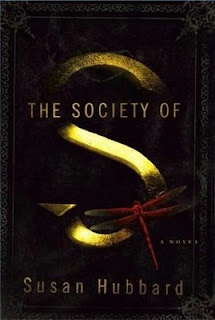
The Society of S


Author: Susan Hubbard

Publisher (In Great Britain): Walker Books Ltd

Publication Year (In Great Britain): 2008

Most of the readers will be: Middle school and early high school girls.

Reader's Advisory: If you like vampires, you should probably read Twilight by Stephenie Meyer. It's so hot right now. Or, you could read my favorite vampire book, Sisters of the Night, edited by Barbara Hambly and Martin Harry Greenberg (this is a collection of short stories).

Summary:
Ariella has grown up with her father in a large Victorian house in Sarasota Springs, New York. She is home schooled and very sheltered. The housekeeper, Mrs. McGarritt, convinces Ari's father to let her spend time with her children. Ari becomes close with Mrs. McG's daughter, Kathleen, and her son, Michael.
Once Ari sees how other people live she realizes how strange her own life is. She has many new questions for her father during their afternoon classes. Most of them are questions he doesn't want to answer.
After Kathleen is murdered, Ari's father begins to tell her the truth about who they both are and what has happened to Ari's mother. In a deep depression, Ari hitchhikes south in search of her mother and the missing pieces she needs to complete the puzzle.

My favorite passage:
I forced myself to read a collection of poetry by Edgar Allan Poe, and it was tough going. I'd suffered through The Narrative of Arthur Gordon Pym, which seemed to me painfully overwritten. But the poetry was even worse. In an hour my father would be upstairs, expecting me to have insights into meter and rhyme, and all I could think about was that Michael (and Kathleen) were out shopping, and that I wouldn't see them at all that day.
Mrs. McG had made me an omelet for lunch, so watery and tasteless that I couldn't make myself eat more than a few bites of it. I wondered why her cooking tasted so much better at her house.
When I met my father in the library at one, I said, "You know, I don't think much of Poe's poetry."
He was sitting at the desk, and one of his eyebrows lifted. "And how much of it have you read, Ariella?"
"Enough to know that I don't like it." I talked quickly, to hide the truth: I'd read the first and last stanzas and skimmed the rest. I tried to explain. "The words are just ... words on the page."
"Which one were you reading?" How like him, to know I'd read only one.
I opened the book and handed it to him. "'Annabel Lee,'" he said, his voice caressing the name. "Oh, Ari. I don't think you've read it at all."
And he read the poem aloud to me, barely glancing at the book, never pausing between the lines or stanzas, and the words were like music, the saddest song in the world. When he read the final lines ("And so, all the night-tide, I lie down by the side / Of my darling–my darling–my life and my bride / In her sepulchre there by the sea– / In her tomb by the sounding sea."), I was crying. And when he looked up from the book, I saw tears in his eyes.
He recovered quickly. "I'm sorry," he said. "Poe was a bad choice."
But I couldn't stop crying. Embarrassed, I left him and went upstairs, lines of the poem still sounding in my head: "For the moon never beams, without bringing me dreams / Of the beautiful ANNABEL LEE; / And the stars never rise, but I feel the bright eyes / Of the beautiful ANNABEL LEE."
I fell onto my bed and cried as I'd never cried before–for my mother and father and me, and all that we'd been and might have been, and all that had been lost. (pg 54-55)


What I really think:
After reading a book which so heavily features Whitman (not my favorite poet) you can imagine what a pleasant surprise it was to find that this book features Poe (quite possibly my favorite poet).
I like Ari's voice. She sounds like a very intelligent child. Not too intelligent to be believable. It's just right. The way she sometimes talks directly to the reader reminds me of Jane Eyre.
So, Poe references and a strong voice, what's not to love? Um, I wasn't crazy about the vampire business. It's not that I don't like vampires, it's just that I like to see an individual author's "world that contains vampires" be really unique. Tell me something I don't already know. Make me feel something about vampires I don't already feel. Yeah, Hubbard's rules for vampires are a little different from the traditional, but I wasn't totally sold. It felt kind of like a regualr coming of age story with vampirism thrown in to get teens to read it. (Because vampires are so hot right now.)
I remained interested throughout the book, but was well and truly disappointed by the Epilogue. It reminds me of the ending of Stacy (this movie is the reason I'm no longer allowed to pick movies when hanging out with friends). Ari hopes for a future in which humans and vampires openly share the world with one another. Gag.